There is more in the space than we can see.
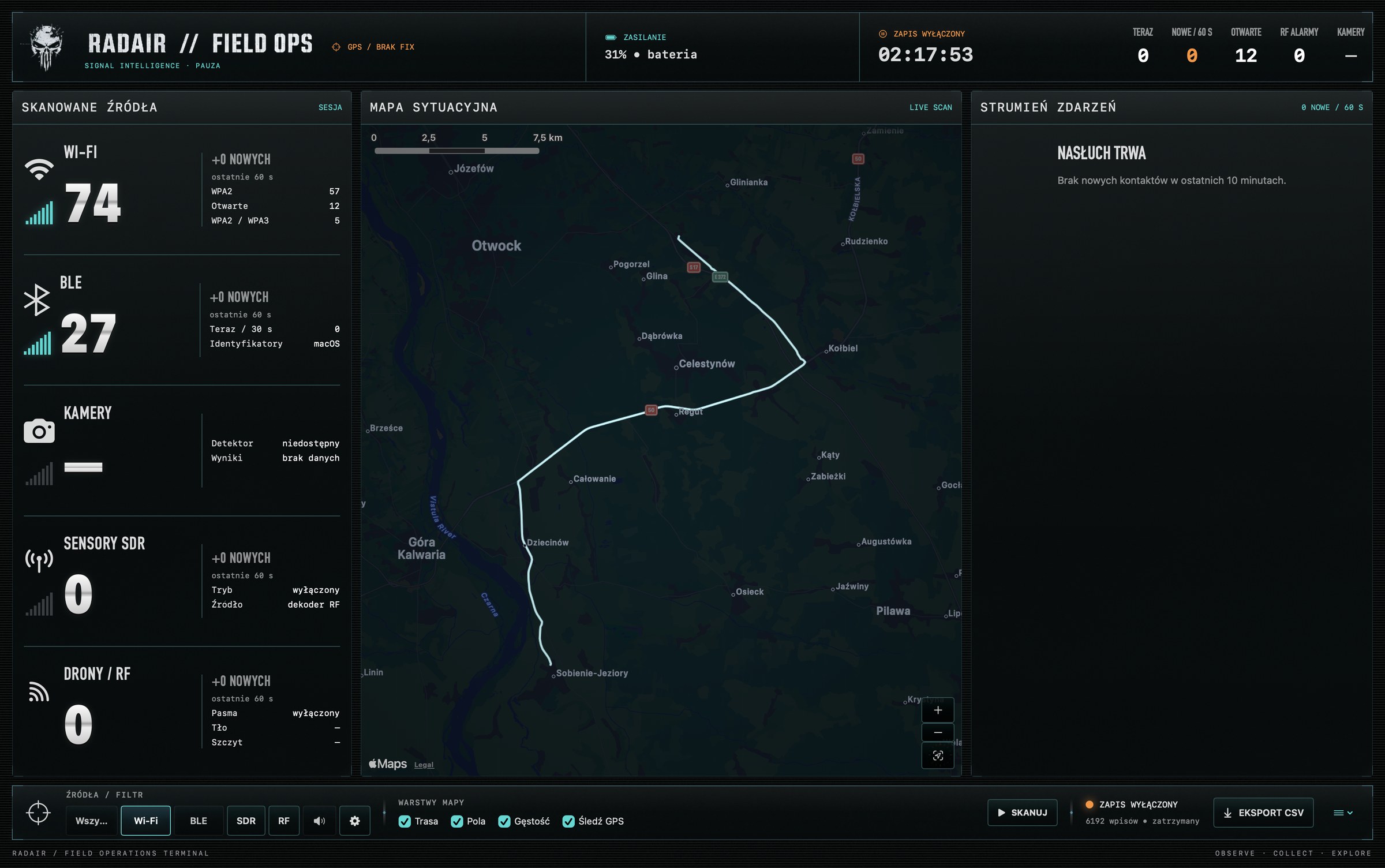
An operator drives down a street and sees roads, buildings and a car ahead. That same space is saturated with radio activity that has no visual form. RadAir is an experimental macOS platform for observing that second layer — watch the street dissolve into it.
The city starts to emit.
Turn the sensors on and the physical scene comes alive. Points lift off every rooftop, beacon and the vehicle itself — each building is a source, a reflector, a cluster of devices. The street you were just looking at is quietly broadcasting.
The street becomes a wavefield.
Once the surfaces dissolve, propagation is all that is left — a living field where every reflector and handset adds energy. The road you drove is now a set of moving wavefronts.
Radio has a shape.
RadAir renders that raw energy as a kernel-density heatmap before it ever names a single device — where the air is busy, and where it is quiet.
A pedestrian resolves, one device at a time.
One person walking past is not one signal. Scan them and they resolve device by device — earbuds, a heart-rate strap, a fitness watch, a randomised handset MAC, a key fob and a GNSS shadow. RadAir separates the wearer from the wearables.
Detection is not intelligence.
Raw observations are noisy and transient. Repeated measurements collapse into persistent RF entities with history, location, signal characteristics and explicit confidence.
A vehicle collects as it drives.
The picture is built in motion. As the collection vehicle follows its route, every entity it passes is geolocated and timestamped — and compared against reference passes of the same ground.
One thing is not background.
The baseline greys out everything ordinary. RF-031 survives: absent from five reference passes, reacquired at separated points, stable center frequency, +18 dB above local baseline.
Direction turns detection into a search area.
RadAir never infers bearing from ordinary RSSI. With a DF-capable provider, real bearing measurements are fused with vehicle position — and a live spectrum waterfall confirms the emitter — to narrow the probable source location.
AI is the last layer, not the sensor.
The final output is not a chatbot guessing about RF. It is an operator-readable synthesis of measured evidence: what happened, why it matters, how certain the system is, and the next useful action.